From Energy Monitoring to Intelligent Decision-Making: A Scalable BEMS architecture for Smart Buildings powered by NXP i.MX 95
2026/5/12
Industry Trends
Smart buildings that can think are no longer a future vision, they are becoming reality.
In the past, Building Energy Management Systems (BEMS) were mainly used to read meters, record electricity usage, and generate monthly reports. Their role was passive, focusing only on helping people understand how much energy they consumed.
Recently, the situation has changed dramatically. Electricity costs continue to rise, and companies are under increasing pressure to reduce carbon emissions. ESG is no longer optional, it has become a key business KPI. Governments are also introducing stricter regulations, requiring transparency and compliance in energy usage.
As a result, BEMS has evolved from a simple monitoring tool into an intelligent system that can analyze, predict, and make decisions in real time.
What's New in Modern BEMS
Modern BEMS is no longer limited to tracking energy consumption. It now manages the entire energy ecosystem within a building.
It connects and controls systems such as air conditioning, lighting, energy storage, and EV chargers. More importantly, it can make real-time decisions. It can determine when to turn on the air conditioning, when to prioritize stored energy, and when to send excess power back to the grid.
With AI and edge computing, the system can predict peak demand and respond instantly without relying on the cloud. Meanwhile, the cloud still plays an important role in managing multiple buildings or even entire communities.
BEMS has become the “central nervous system” of smart buildings: not only improving efficiency, but also driving energy transformation.
Challenges
While the vision of intelligent BEMS is clear, implementing it is not easy.
Many systems, such as lighting, energy storage, and EV charging, require a real-time response. Without sufficient computing performance, the system may become unstable or fail.
At the same time, BEMS projects are long-term investments, often lasting more than ten years. This requires strong security, reliability, and long product lifecycle support.
Scalability is another challenge. Some deployments are small, covering a single building, while others expand to entire communities. The system must be flexible enough to scale up or down.
Traditionally, each project is developed from scratch. This leads to high development costs, long time-to-market, and limited ability to replicate success across projects.
Solutions
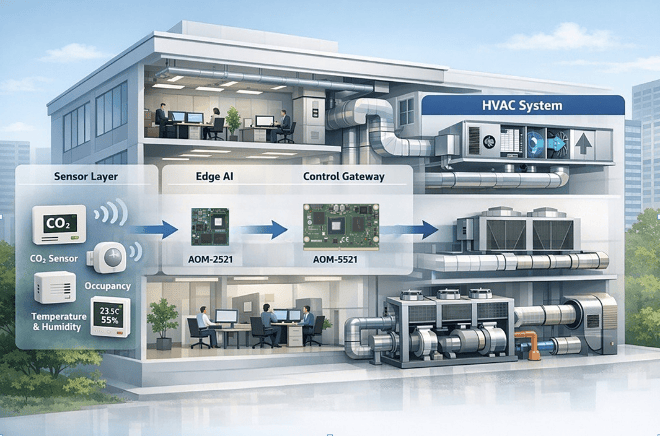
To address these challenges, Advantech and its customers developed a scalable and reusable platform based on NXP i.MX 95.
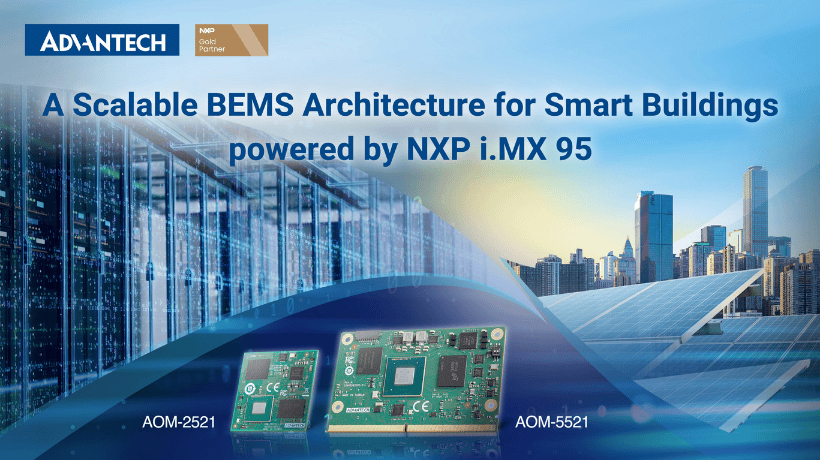
By combining Advantech’s SMARC module (AOM-5521) and OSM module (AOM-2521), the system introduces a distributed intelligence architecture. The building operates with a "big brain", while each device is equipped with its own "small brain".
This approach allows the entire system to work together efficiently while maintaining flexibility at the device level.
How It Works
At the edge, the OSM modules are embedded into devices such as meters, controllers, energy storage systems, and EV chargers. These modules handle real-time control and local data processing. They ensure fast response times and reduce dependency on centralized systems.
Together, this architecture enables every device to become intelligent, while the entire building operates as a coordinated system.
Why Advantech chooses NXP i.MX 95
The NXP i.MX 95 processor is designed not just for AI performance, but for industrial intelligence.
It integrates CPU, GPU, NPU, and MCU into a single platform, enabling both high-level computing and real-time control. With up to six Cortex-A55 cores and a 2 TOPS NPU, it supports AI applications efficiently, while the integrated Cortex-M7 and M33 cores handle real-time control and safety-critical tasks.
The platform also provides strong security through EdgeLock® Secure Enclave, ensuring secure boot, key management, and data protection. Functional safety features, including support for ISO 26262 and safety island architecture, make it suitable for industrial environments.
In addition, the i.MX 95 offers a long product lifecycle of up to 15 years, ensuring stability for long-term deployments. With tools such as the NXP eIQ® toolkit and Advantech WEDA AI SDK, developers can easily deploy and optimize AI applications at the edge.
Results
With this platform, Advantech and its customers have moved from project-based development to platform-based growth.
Development cycles are significantly shortened, as the same software framework can run across both SMARC and OSM modules. System costs are reduced because there is no need to redesign for each project.
Energy efficiency is improved through real-time decision-making at the edge. At the same time, the system can scale easily, from a single room, to a building, and even to an entire community.
This unified platform enables consistent performance, faster deployment, and better long-term value.
Conclusion
BEMS is no longer just about monitoring energy consumption. It has become the core system driving energy transformation, from passive observation to real-time decision-making and continuous optimization.
With the combination of Advantech’s modular design and NXP i.MX 95’s industrial intelligence, this transformation is not only possible, but already happening.
Smart buildings are no longer just efficient, they are becoming intelligent systems that can think, adapt, and evolve.
-25/AOM-2521-150KB20260205111031.png)
-25/AOM-5521_3_150KB20260205132524.png)